
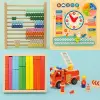





As children push the walker and handle the blocks, they engage multiple areas of development at the same time. The combination of movement, balance and object manipulation helps build coordination and confidence during the early stages of walking and play.
Motor Skill Development
Wooden baby walkers support both gross and fine motor development. Gross motor skills are involved when children push the walker forward, practise balance and learn to coordinate their steps.
Fine motor skills develop as children pick up, stack and rearrange the wooden blocks stored in the walker. These small hand movements help strengthen finger control and improve coordination between the hands and eyes.
Spatial Awareness and Problem Solving
Stacking and arranging blocks helps children develop an understanding of shapes, balance and space. As they experiment with placing blocks in different positions, they begin to recognise how objects fit together and how structures remain stable.
These early experiences with spatial relationships support later learning in activities such as puzzles, construction toys and drawing.
Imagination and Creative Play
Block walkers also encourage open-ended play. Children can build simple towers, line up blocks or create small structures using their imagination.
Because the blocks can be arranged in many different ways, children are free to experiment and create new ideas each time they play. This type of flexible play helps develop creativity and independent thinking.
Cognitive Development
Playing with wooden blocks introduces children to early problem-solving. They learn how objects balance, how pieces fit together and how different shapes interact.
Through repeated play, children also begin to recognise patterns, compare sizes and practise basic counting. These experiences support early cognitive development in a natural and playful way.
Sensory Experience
Wooden toys provide a different sensory experience compared with many plastic toys. The texture, weight and shape of wooden blocks allow children to explore materials through touch.
Handling different block shapes also helps children refine their sense of movement and control as they grasp, turn and place objects.
Social Interaction
Wooden baby walkers can also support social play. When children play together they may share blocks, build structures or take turns pushing the walker.
These interactions encourage communication, cooperation and early social skills as children learn to play alongside others.
Durability and Longevity
Wooden baby walkers are typically made from solid timber components and simple mechanical designs. This construction makes them durable and able to withstand regular use.
Because of their sturdy design, wooden walkers are often reused by younger siblings or passed on to other families, allowing them to remain in use for many years.
Many toys designed for early movement and coordination can be found in our Infant Toys collection.
Conclusion
Wooden baby walkers combine movement, block play and hands-on exploration in a single toy. By encouraging children to push, stack and experiment with objects, these toys help support motor development, coordination and creative play during the early stages of childhood.


